


The Western House Martin is widespread and occurs mainly in open and semi-open terrain. It builds its nests primarily on buildings with sufficient space under the roof, but less commonly also nests on rock faces or in quarries. For its food it preys exclusively on small to medium-sized flying insects.
The population of the Western House Martin has been declining throughout Switzerland since the 1990s, and in 2010 the species was classified as Near Threatened for the first time.
Nests on buildings are heavily dependent on human influences. The nests, which are reused year after year, are often lost during construction projects or are no longer tolerated. The loss of insect biomass and nest-building material is also having an adverse impact. Western House Martins can be helped by showing them consideration, raising awareness and providing artificial nests.

©
© Marcel Burkhardt
Conservation programme for birds in Switzerland - Priority species
Western House Martin
Distribution and development
Schematic distribution

Schematic distribution during the breeding season (ochre), in winter time (dotted in blue) or during migration periods (dotted in vinaceous).
Breeding bird index
The graph shows the relative evolution of the breeding population in Switzerland (100 = mean value). Example: A value of 130 means that the population in the corresponding year was 30% above the mean value of the entire period considered.
Habitat and food

©
© Stephanie Michler
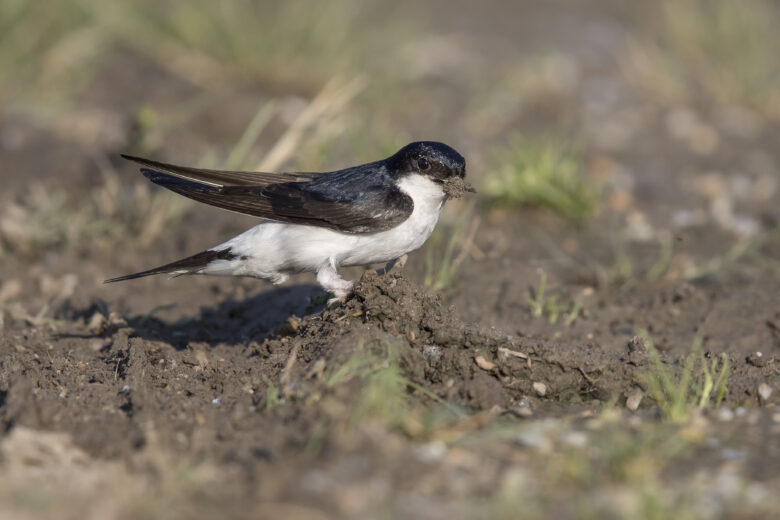
Open muddy areas are essential for them to collect nest-building material.

©
© Stephanie Michler
The Western House Martin likes to build its mud nests, which it uses year after year, on rough exterior facades under a roof with a good overhang.

©
© Merline Roth
Western Northern House Martins will use artificial nests – even in the middle of a built-upurban area, such as here at the Birs quayside in Birsfelden BL.

©
© Stephanie Michler
Open muddy areas are essential for them to collect nest-building material.

©
© Stephanie Michler
The Western House Martin likes to build its mud nests, which it uses year after year, on rough exterior facades under a roof with a good overhang.

©
© Merline Roth
Western Northern House Martins will use artificial nests – even in the middle of a built-upurban area, such as here at the Birs quayside in Birsfelden BL.


Conservation programme for birds in Switzerland - Priority species
Western House Martin
The Western House Martin is widespread and occurs mainly in open and semi-open terrain. It builds its nests primarily on buildings with sufficient space under the roof, but less commonly also nests on rock faces or in quarries. For its food it preys exclusively on small to medium-sized flying insects.
The population of the Western House Martin has been declining throughout Switzerland since the 1990s, and in 2010 the species was classified as Near Threatened for the first time.
Nests on buildings are heavily dependent on human influences. The nests, which are reused year after year, are often lost during construction projects or are no longer tolerated. The loss of insect biomass and nest-building material is also having an adverse impact. Western House Martins can be helped by showing them consideration, raising awareness and providing artificial nests.
The population of the Western House Martin has been declining throughout Switzerland since the 1990s, and in 2010 the species was classified as Near Threatened for the first time.
Nests on buildings are heavily dependent on human influences. The nests, which are reused year after year, are often lost during construction projects or are no longer tolerated. The loss of insect biomass and nest-building material is also having an adverse impact. Western House Martins can be helped by showing them consideration, raising awareness and providing artificial nests.
Birds of Switzerland

Western House Martin
To the species profile in the bird database
Project managers


Threats, activities and forecasts
Limiting factors and threats
The disappearance of nest sites during construction projects, the lack of nesting material due to soil sealing and dry weather in spring, the decline in flying insects due to intensification of agriculture and modern construction methods are all risk factors for the Western House Martin.
Breeding season
- Shortage of nest-building material (soil sealing) and lack of structures to build nests on in modern buildings.
- Diminishing tolerance of building residents towards broods and, in some cases, deliberate destruction of nests.
- Decrease in biomass of flying insects.
Migration/ Winter
- Periods of bad weather during migration can lead to losses.
- Adequate food supply during migration and at the wintering grounds.
- In some countries, martins are hunted illegally.
Necessary activities
Monitoring
- Population trend is tracked as part of the Swiss Ornithological Institute’s monitoring projects (monitoring of common breeding birds).
- Local projects run by volunteers record the number and occupancy of nests, sometimes over many years.
- Effectiveness checks after the installation of nesting aids.
Conservation
- The Swiss Ornithological Institute’s inventory of building-nesting birds aims to protect nesting sites (taking nests into account in construction projects).
- Many BirdLife sections and private individuals are installing artificial nests (especially if there is a shortage of nest-building material). This is particularly effective close to existing colonies.
- Habitat improvement around colonies would be required (e.g. unsealing of soils, naturalistic gardens).
- Keeping muddy puddles wet.
Research
- Examine the effects of insect decline on breeding success and population development.
- Acquire knowledge about factors that influence the long-term survival of colonies.
Prospects for success and prognostics
- Western House Martins have a close association with man-made structures and are therefore heavily dependent on human tolerance. Raising awareness among residents and building owners is vital.
- Artificial nests are a very effective measure when used optimally: close to an existing colony, installed properly, droppings boards fitted.
- Effects of climate change on insect biomass and migration mortality should be borne in mind.
Conservation measures and stakeholders

Take nesting sites into consideration in construction projects
The preservation of existing nesting sites is very important for the Western House Martin, as it always returns to the same place to breed. Inventories of building-nesting birds are a key element here.
Cantons
Facility management
Municipalities
Private individuals

Offer and maintain nesting aids
The provision of nesting aids is particularly valuable in places close to existing colonies and where no nest-building material is available.
Facility management
Industry and commerce
Municipalities
Nature conservation
Private individuals

Create ecological compensation areas
Ecological compensation areas in agricultural regions can encourage insects, which in turn provide food for Western House Martins.
Agriculture
Cantons
Municipalities

Create / increase crop diversity
Small plots and diverse agricultural landscapes, as well as semi-natural built-up areas and gardens, provide habitat and food sources for many bird species.
Agriculture
Horticultural businesses
Municipalities
Planners and architects
Private individuals



©
© Marcel Burkhardt
Birds of Switzerland
Western House Martin
The Northern House Martin has more and more problems in finding suitable nesting sites although towns and villages are growing. Unfortunately, nests are often wilfully destroyed because these insectivores can soil houses and the surrounding area with their droppings. With a bit of goodwill, reasonable solutions can be found by hanging up artificial nests in places where they cannot c...
To the species profile in the bird database

