


©
© Marcel Burkhardt
Conservation programme for birds in Switzerland - Priority species
Alpine Swift
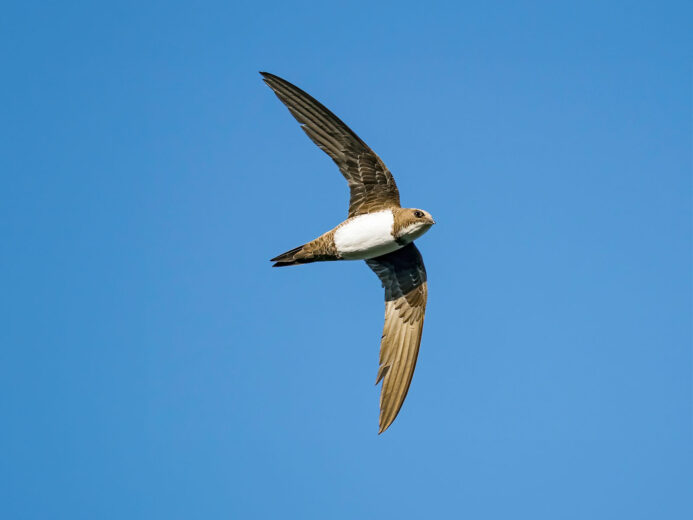
The Alpine Swift was originally an inhabitant of rocky landscapes. In the Alps and locally in the Jura it nests in sheltered spots on rock faces. However, it has now also moved into urban areas, and today more than 80 % of pairs nest in buildings. This development has been accompanied by an increase in its population and an expansion of its range. Today, there are 1,800–2,300 pairs in Switzerland. Breeding sites are usually below 1500 m asl. However, building-nesting birds, such as the Alpine Swift, are potentially at risk from building demolitions and renovations to improve energy efficiency. In the long term, the only way to preserve the population is by protecting and preserving existing breeding colonies and creating new nesting sites.
Distribution and development
Schematic distribution

Schematic distribution during the breeding season (ochre), in winter time (dotted in blue) or during migration periods (dotted in vinaceous).
Breeding bird index
The graph shows the relative evolution of the breeding population in Switzerland (100 = mean value). Example: A value of 130 means that the population in the corresponding year was 30% above the mean value of the entire period considered.
Habitat and food


Conservation programme for birds in Switzerland - Priority species
Alpine Swift
The Alpine Swift was originally an inhabitant of rocky landscapes. In the Alps and locally in the Jura it nests in sheltered spots on rock faces. However, it has now also moved into urban areas, and today more than 80 % of pairs nest in buildings. This development has been accompanied by an increase in its population and an expansion of its range. Today, there are 1,800–2,300 pairs in Switzerland. Breeding sites are usually below 1500 m asl. However, building-nesting birds, such as the Alpine Swift, are potentially at risk from building demolitions and renovations to improve energy efficiency. In the long term, the only way to preserve the population is by protecting and preserving existing breeding colonies and creating new nesting sites.
Birds of Switzerland

Alpine Swift
To the species profile in the bird database
Project managers


Threats, activities and forecasts
Limiting factors and threats
Nesting sites in and on buildings are constantly under threat from construction projects. Broods in roller blind housings are also heavily reliant on human tolerance. As a colony breeder, the Alpine swift is sometimes susceptible to predation (e.g. by martens) or diseases.
Breeding season
- Availability of suitable nesting sites in buildings limits distribution and number of pairs.
- Bad weather and disease during the breeding season are detrimental to breeding success.
Migration/ Winter
- Climatic anomalies during the winter or during bird migration can force Alpine Swifts to land.
- Exposure in wintering grounds to pesticides banned in Europe.
Necessary activities
Monitoring
- Population trend is tracked as part of the Swiss Ornithological Institute’s monitoring projects (monitoring of common breeding birds).
- Trend in the Alpine Swift population in a number of building-based colonies is monitored by the Swiss Ornithological Institute in collaboration with volunteer colony guardians.
- Monitoring the situation of populations in natural habitats and protecting these breeding colonies would be beneficial
Conservation
- Protection of nesting sites during construction projects, e.g. through inventories of building-nesting birds.
- Provision of artificial nesting aids – to be included in planning for renovations, but also for new-builds
- Awareness-raising and advice for stakeholders and other parties involved.
Research
- Impact of climate change on health and demographics.
- Impact of insecticides and other harmful substances on health and demographics.
- Research into diseases and their impact on colonies.
Prospects for success and prognostics
- Apart from possible weather-related setbacks during the breeding season, there is nothing to prevent a further increase in the population of building-nesting birds.
- However, the population would probably fall rapidly if the protection and conservation measures were not continued.
Conservation measures and stakeholders

Take nesting sites into consideration in construction projects
Known nesting sites of building breeders (e.g. via inventories in municipalities) should be taken into account in construction projects.
Show more
Cantons
Facility management
Municipalities
Planners and architects
Private individuals

Offer and maintain nesting aids
Installing and maintaining nest boxes or artificial nests helps counteract the lack of natural nesting sites.
Show more
Facility management
Municipalities
Nature conservation
Planners and architects
Private individuals



©
© Marcel Burkhardt
Birds of Switzerland
Alpine Swift
When the Common Swifts have left as from the end of July, the Alpine Swifts have the airspace above our towns to themselves. Bands of adult birds and their young zoom about high above chasing each other and twittering loudly in their aerial displays. The large falcon-like Alpine Swifts occur in two different habitats in our country: They breed in cliffs in the Alps and regionally in ...
To the species profile in the bird database

