


©
© Marcel Burkhardt
Conservation programme for birds in Switzerland - Priority species
Common Swift
The Common Swift is widespread in villages and towns, with the population concentrated in the Central Plateau. It has occasionally been seen to breed at over 2000 m asl. As a nesting site the Common Swift chooses dark, usually small, crevices in buildings, to which it faithfully returns year after year. However, many breeding sites are being lost due to the renovation or demolition of buildings, so protecting and preserving them is essential in order to maintain the population. This requires reliable inventories, as well as the involvement of multiple stakeholders such as cantons/municipalities and planners in construction projects. The use of nesting aids is often an easy way of conserving and creating additional nesting sites.
Distribution and development
Schematic distribution

Schematic distribution during the breeding season (ochre), in winter time (dotted in blue) or during migration periods (dotted in vinaceous).
Breeding bird index
The graph shows the relative evolution of the breeding population in Switzerland (100 = mean value). Example: A value of 130 means that the population in the corresponding year was 30% above the mean value of the entire period considered.
Habitat and food

©
© Merline Roth
Entrance holes under the eaves in the city of Basel.

©
© Merline Roth
Common Swift boxes on the roof pitch of an old farmhouse in Ostermundingen BE.


Conservation programme for birds in Switzerland - Priority species
Common Swift
The Common Swift is widespread in villages and towns, with the population concentrated in the Central Plateau. It has occasionally been seen to breed at over 2000 m asl. As a nesting site the Common Swift chooses dark, usually small, crevices in buildings, to which it faithfully returns year after year. However, many breeding sites are being lost due to the renovation or demolition of buildings, so protecting and preserving them is essential in order to maintain the population. This requires reliable inventories, as well as the involvement of multiple stakeholders such as cantons/municipalities and planners in construction projects. The use of nesting aids is often an easy way of conserving and creating additional nesting sites.
Birds of Switzerland

Common Swift
To the species profile in the bird database
Project managers


Threats, activities and forecasts
Limiting factors and threats
The greatest risk to the Common Swift comes from the loss of nesting sites – for example due to the restoration, demolition of buildings or renovations to improve energy efficiency. By contrast, declines in populations due to weather conditions are often compensated within a few years.
Breeding season
- Availability of suitable nest cavities.
- Destruction of existing nest sites during construction projects.
Migration/ Winter
- Long periods of bad weather during migration can lead to losses.
- Exposure in wintering grounds to pesticides banned in Europe.
Necessary activities
Monitoring
- Trends in individual Common Swift colonies are monitored by the Swiss Ornithological Institute in collaboration with volunteer colony guardians.
Conservation
- Protect and preserve nesting sites during construction projects by drawing up inventories of building-nesting birds.
- Install artificial nesting aids as replacements during the construction period.
- Use nesting aids to expand the supply of nesting sites.
- Awareness-raising and advice for stakeholders and other parties involved.
Research
- Examine the effects of insect decline on breeding success and population development.
- Investigate whether the population trend determined by the development of individual colonies is actually correct, because usually only well-maintained colonies are included in the calculations.
Prospects for success and prognostics
- The Common Swift breeds in many places, but numerous breeding sites are being lost due to the renovation or demolition of older buildings.
- Provided these breeding sites are consistently protected, the species will probably be able to maintain its population well.
- Given relevant information and encouragement, wide use of nesting aids could be made for Common Swift conservation.
Conservation measures and stakeholders

Take nesting sites into consideration in construction projects
Protecting existing nesting sites is key to preserving the Common Swift population, as pairs always return to the same breeding site. Inventories of building-nesting birds are an important element here.
Cantons
Facility management
Municipalities
Planners and architects
Private individuals

Offer and maintain nesting aids
The supply of suitable nest cavities is limited. However, these can be easily and successfully imitated by nesting aids.
Municipalities
Nature conservation
Planners and architects
Private individuals



©
© Marcel Burkhardt
Birds of Switzerland
Common Swift
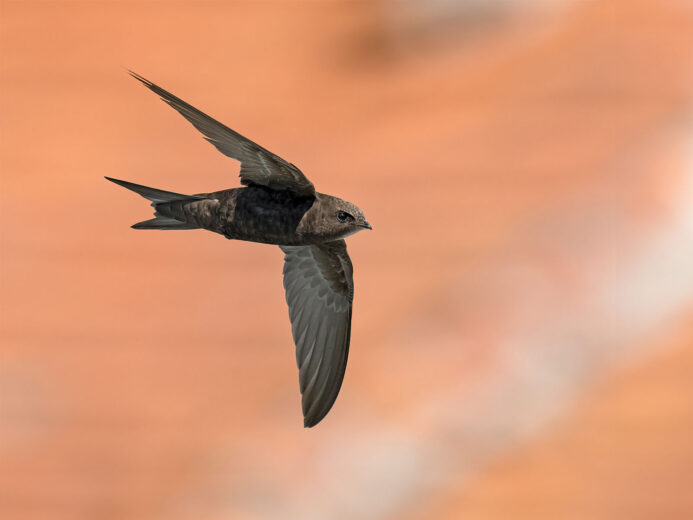
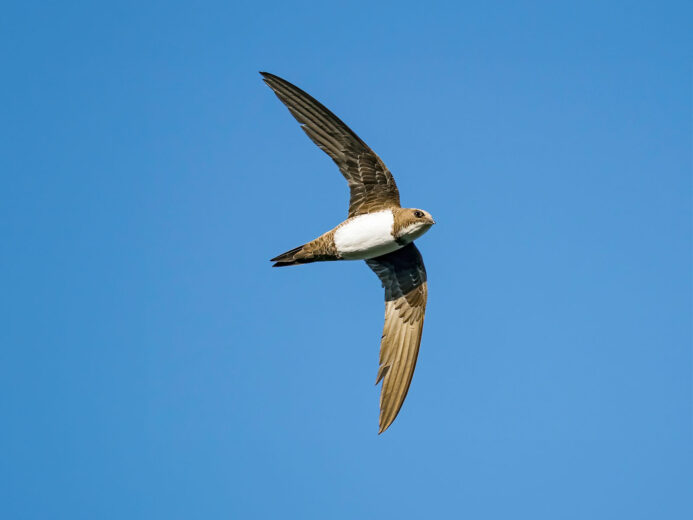
Hardly any other bird is adapted better to life in the air than the Common Swift. This excellent aerial hunter resembles a swallow but flies at breakneck speed. It sleeps and mates on the wing. With Common Swifts wheeling higher and higher at dusk, it used to be thought that they returned when it was dark or spent the night on the moon. Emil Weitnauer, an ornithologist who lived near...
To the species profile in the bird database

