Whinchat
©
© Ralph Martin
Conservation programme for birds in Switzerland - Priority species

Whinchat

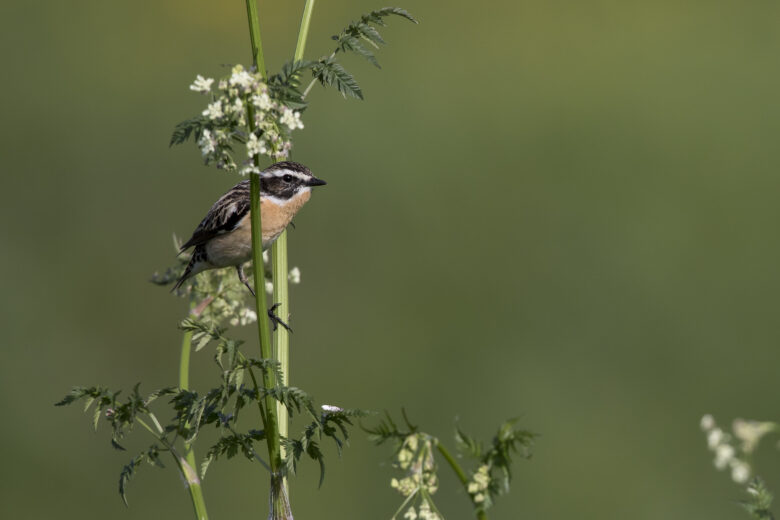
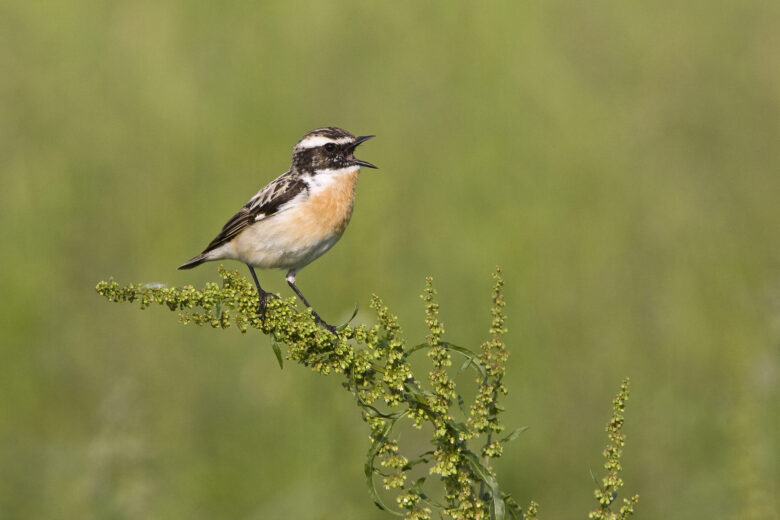
The Whinchat is a bird characteristic of diverse, insect-rich meadows and pastures. This long-distance migrant returns from Africa in mid-April to breed in Switzerland between May and August. The intensification of grassland use has led to a massive decline in the population since 1950. This once widespread ground-nesting bird is now found almost exclusively at higher elevations in the Alps and the Jura. But even in these last refuges, it is under increasing pressure. In the long term, populations can be preserved only if habitat quality is maintained in its breeding areas. Specifically, it needs permanent access to large (≥ 20 ha) areas more than 60 % covered by extensively used meadows that are mown late (from mid-July onwards).

Distribution and development

Schematic distribution
Verbreitung - Whinchat
Schematic distribution during the breeding season (ochre), in winter time (dotted in blue) or during migration periods (dotted in vinaceous).
Breeding bird index
The graph shows the relative evolution of the breeding population in Switzerland (100 = mean value). Example: A value of 130 means that the population in the corresponding year was 30% above the mean value of the entire period considered.
Distribution and prevalence in Switzerland
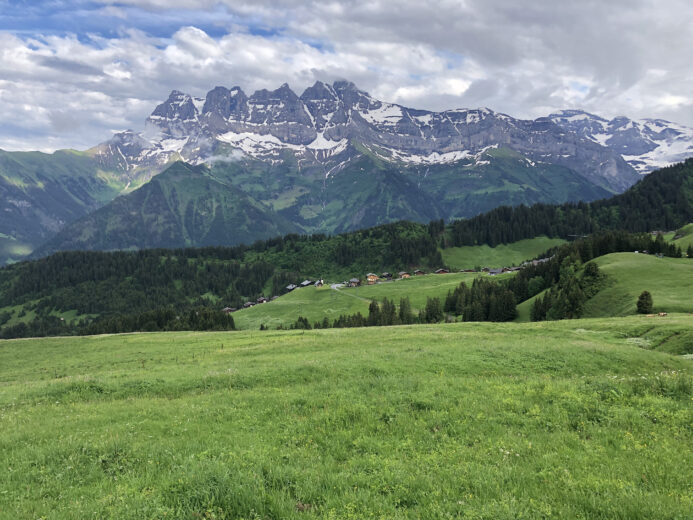
  • Practically disappeared from the Central Plateau, still occasionally seen in the Jura, mainly found at 1600–2100 m asl
  • Population has halved since 1993–1996, with 5000–7000 pairs in 2013–2016.
  • Grisons and Valais are home to approx. 65 % of the national population, while Bern, Vaud and Ticino account for 7-8 % each.
Development in Switzerland
  • Central Plateau: declining since the 1950s, virtually abandoned between the 1970s and 1990s.
  • Decrease since the 1990s in the Jura, the foothills of the Alps and Alpine valleys.
  • Shift to higher elevations since 2014 (downward trend below 1750 m asl, upward above).
International
  • Breeding grounds in Europe and western Asia, wintering grounds in sub-Saharan Africa.
  • 2021: 10’250’000–14’050’000 breeding pairs, over 50 % of populations are in NE Europe and W Russia.
  • Declining across Europe, significant population decreases, especially in western and central Europe.

Habitat and food

Habitat
Alpine habitats
Dwarf shrub heath
Wetlands and water bodies
Wetlands, Marshes
Farmland
Moors and heathland, Meadows and pastures
Food
Insects and spiders
Insects, Spiders, Grasshoppers, Insect larvae, Small insects
Fruits
Berries
Worms
Invertebrates
Habitat and food requirements

The Whinchat prefers open, diverse, lightly fertilized meadow areas, but also inhabits alpine pastures, wetlands and alpine dwarf shrub heath. Essential elements are singing/hunting perches, not too many trees/shrubs and at least 100 m away from forest.

Feeding habitat

  • A perch hunter, it relies on elevated structures (e.g. tall plants, fences) from which it can catch insects.
  • To access food, it needs areas with low and patchy vegetation.

Nesting site

  • The nest is built by the female in a small depression in the ground (ground nester) in particularly dense vegetation (protection against being seen from above).
  • Often at the foot of or near a prominent perch.

Winter habitat

  • Overwinters in African savannah areas.
  • Regular migrant throughout Switzerland, particularly in agricultural habitats and wetlands in the lowlands.
Conservation programme for birds in Switzerland - Priority species

Whinchat

The Whinchat is a bird characteristic of diverse, insect-rich meadows and pastures. This long-distance migrant returns from Africa in mid-April to breed in Switzerland between May and August. The intensification of grassland use has led to a massive decline in the population since 1950. This once widespread ground-nesting bird is now found almost exclusively at higher elevations in the Alps and the Jura. But even in these last refuges, it is under increasing pressure. In the long term, populations can be preserved only if habitat quality is maintained in its breeding areas. Specifically, it needs permanent access to large (≥ 20 ha) areas more than 60 % covered by extensively used meadows that are mown late (from mid-July onwards).
Priority species at national level
The ‘responsibility’ factor describes the international significance of the Swiss population of a species. The allocation to responsibility classes was based primarily on geographical distribution (Switzerland, Europe or worldwide) and the genetic and/or ecological significance of Swiss populations.
  • Exclusive responsibility
  • Very high responsibility
  • High responsibility
  • Responsibility
  • Joint responsibility
  • Minimal joint responsibility
Operational level
The level at which measures should be taken for all national priority species is specified within the framework of specific 'species conservation' (SC), 'habitat conservation' (HC), or the biodiversity-friendly use of natural resources on the ""entire territory"" (ET) by all sectoral policies. Each species has been assigned to only one level. If measures at the 'entire territory' (ET) level are insufficient for the conservation and promotion of the species, measures at the second level, 'specific habitat conservation' (HC), are required. If this is also insufficient, specific 'species conservation' (SC) measures must also be applied. Therefore, a species requiring specific species conservation measures must also be given special consideration when implementing measures at the 'specific habitat conservation' and 'entire country area' levels.
  • SC species conservation
  • HC habitat conservation
  • NT national territory
SC
Urgency
An expert assessment was made of the urgency with which measures should be implemented, continued and/or newly planned for all species assigned to the specific 'species conservation' and 'habitat conservation' action levels. The two factors of endangerment and international responsibility were considered, as were the prospects of success.
  • Urgent
Circle
Circle
Circle
Population in Switzerland
(2025)
The population estimate indicates how many pairs bred during the specified period. As this number fluctuates from year to year and due to uncertainties in population surveys, a range is given. For some species that are difficult to survey, only displaying males are listed. The population estimates cannot be simply doubled to derive the number of individuals. The number of birds is much higher after the breeding season, some birds take years to reach reproductive maturity, and in some cases the sex ratio is not 1:1.
6000-9000pairs
Red List
Red lists are based on the scientific criteria of the IUCN and assess the risk of extinction of a species. This helps to identify where there is a particularly urgent need for action in nature conservation.
  • Vulnerable (VU)

Project managers

Threats, activities and forecasts
Limiting factors and threats

The Whinchat is a victim of intensive grassland use in its breeding grounds. In addition, habitat is being lost due to encroachment (reforestation), infrastructure and disturbance. Losses in wintering grounds probably have little impact on population trends.

 
Breeding season
  • Mowing too early and too frequently kills many broods (and some breeding females).
  • Reduced supply of insects (quantity and accessibility) due to fertilization and irrigation of meadows.
  • Predation (e.g. foxes, domestic cats).
  • Snowfall during the nestling period leads to brood losses.
 
Migration/ Winter
  • Migration is a challenge for all long-distance migrants (hunting, loss of resting places and food, climate change, light pollution, etc.).
  • However, these problems probably play a minor role compared to habitat loss in the breeding grounds.
Show more
Necessary activities
Monitoring
  • Continue to monitor population trends.
  • Identify main regional distribution areas (baseline mapping).
  • Carry out impact assessments before and after the implementation of measures.
 
Conservation
  • Extensification of maximum possible area as part of ecological compensation and regional conservation projects with partners (especially late mowing of large areas).
  • Further evaluation of conservation measures in priority areas.
  • Advising local stakeholders (farmers, general public) and awareness-raising.
 
Research
  • Continue applied research on the conservation measures that enable the stabilisation or recovery of populations under the current agricultural framework (especially summer grazing areas).
  • Continue knowledge sharing via the International Whinchat Working Group.
Show more
Prospects for success and prognostics
  • In lowlands, large, late-mown meadows are scarce, so only a few individual pairs manage to establish themselves.
  • Only at higher elevations, where there are large areas of extensively managed late-use grassland, does the species have a future.
  • Umbrella species for diverse upland meadows.
  • Impact of climate change and thus on distribution, especially in summer grazing area, is unclear.
  • Unless measures are taken, the critical situation will deteriorate further.
Show more
Conservation measures and stakeholders
Promote late management / use
Large areas mown late are most effective in promoting local populations of ground-nesting birds.
Show more
Agriculture
Cantons
Communities
Promote extensive farming
Unfertilised meadows and avoiding pesticides or mulching promote the diversity of plants and insects and thus the quality of the habitat (nesting sites, food supply).
Show more
Agriculture
Cantons
Communities
Promote extensive grazing

Extensive grazing promotes species- and structure-rich vegetation and keeps grassland areas open (measure against scrub and forest encroachment).

Show more
Agriculture
Cantons
Communities
Nature conservation
Parcs
Promote singing or hunting perches
Individual shrubs, trees or wooden posts can serve as singing and hunting perches and improve habitat quality.
Show more
Agriculture
Cantons
Nature conservation
Parcs
Set up protected areas for breeding

Nests can be protected with areas left untouched during mowing/farming operations. This time-consuming measure is only suitable for small populations in grassland used early in the year.

Show more
Agriculture
Cantons
Nature conservation
Private individuals
Adapted management

Scrub clearance and re-wetting maintain the open character of the landscape and prevent the emergence of forest.

Show more
Agriculture
Cantons
Nature conservation
Parcs
Conservation projects Swiss Ornithological Institute
Agricultural Habitat
Species promotion Whinchat
vogelwarte.ch
Applied research
Spatial prioritisation of areas for species recovery
vogelwarte.ch
Applied research
Use of social attraction for conservation
vogelwarte.ch
Species conservation
Meadow breeders in Valais
vogelwarte.ch
©
© Ralph Martin
Birds of Switzerland

Whinchat

A typical meadow bird in Switzerland, the Whinchat inhabits flower-rich, diverse and extensively managed meadows. It requires little more than a month for breeding. In intensively managed meadows, however, it does not have that much time since ground nests are regularly lost due to frequent mowing. Therefore, today the Whinchat has practically disappeared from the Swiss lowlands. It ...
To the species profile in the bird database

Synergies with other priority species