


©
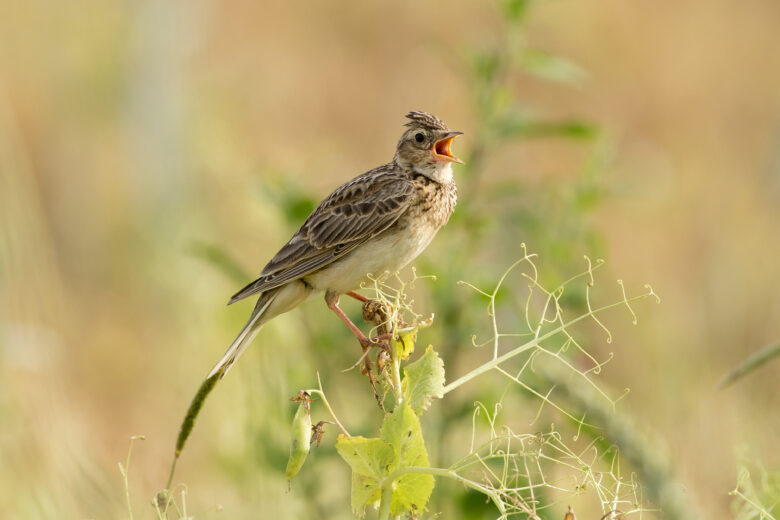
© Mathias Schäf
Conservation programme for birds in Switzerland - Priority species
Eurasian Skylark
The Eurasian Skylark inhabits open agricultural landscapes and avoids tall structures such as trees and urban areas. Its trilling song can often be heard in song flights lasting minutes. It nests on the ground and needs patchy, low vegetation, e.g. in arable land or extensive grassland, for foraging. Since the 1970s, its population has been declining throughout Europe – including Switzerland – due to intensive farming. Today, the Red List classifies it as Vulnerable (VU). Conservation of the Eurasian Skylark requires biodiversity areas in open sites such as wildflower strips or rotational fallow areas, conservation headlands, margins on arable land and extensively managed meadows, as well as measures targeted at production areas, such as broadcasting cereal seed.
Distribution and development
Schematic distribution

Schematic distribution during the breeding season (ochre), in winter time (dotted in blue) or during migration periods (dotted in vinaceous).
Breeding bird index
The graph shows the relative evolution of the breeding population in Switzerland (100 = mean value). Example: A value of 130 means that the population in the corresponding year was 30% above the mean value of the entire period considered.
Habitat and food

©
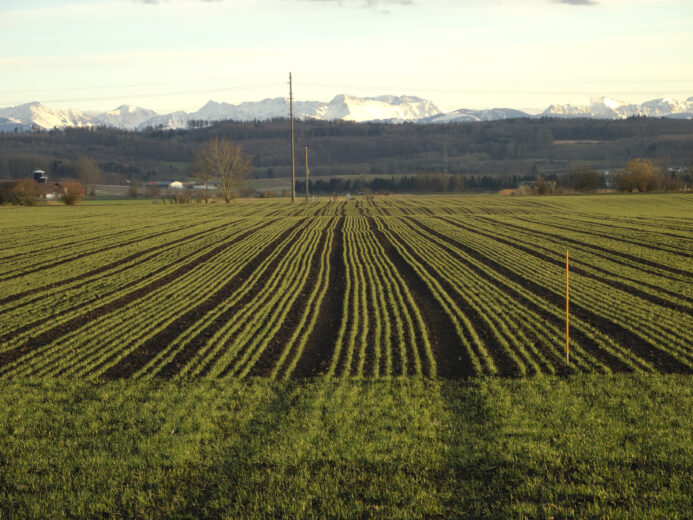
© Markus Jenny
Open arable farming areas (Klettgau SH) are ideal breeding habitat.

©
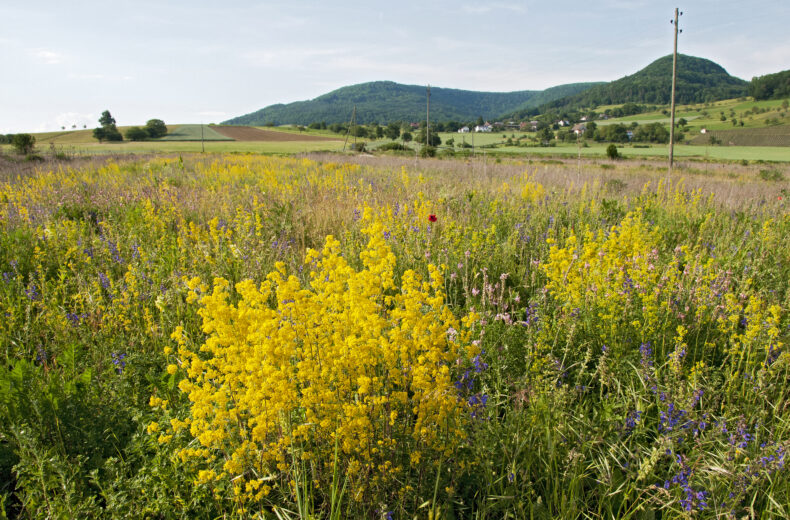
© Claire Lischer
Eurasian Skylarks also inhabit (sub)alpine habitats (Schamserberg GR).


Conservation programme for birds in Switzerland - Priority species
Eurasian Skylark
The Eurasian Skylark inhabits open agricultural landscapes and avoids tall structures such as trees and urban areas. Its trilling song can often be heard in song flights lasting minutes. It nests on the ground and needs patchy, low vegetation, e.g. in arable land or extensive grassland, for foraging. Since the 1970s, its population has been declining throughout Europe – including Switzerland – due to intensive farming. Today, the Red List classifies it as Vulnerable (VU). Conservation of the Eurasian Skylark requires biodiversity areas in open sites such as wildflower strips or rotational fallow areas, conservation headlands, margins on arable land and extensively managed meadows, as well as measures targeted at production areas, such as broadcasting cereal seed.
Birds of Switzerland

Eurasian Skylark
To the species profile in the bird database
Project managers


Threats, activities and forecasts
Limiting factors and threats
Eurasian Skylarks are ground-nesting birds and have several broods to compensate for high breeding losses. However, excessively frequent farming operations are preventing successful breeding, fertilisers and insecticides are having an adverse impact on breeding habitat and food supply, and the spread of human settlement is increasingly leading to habitat disappearance.
Breeding season
- Breeding habitat adversely affected by densely-planted crops, lack of vegetation (e.g. in maize) and fields that are too large.
- Mowing too early and too frequently (intervals of at least 7 weeks required).
- High risk of predation on field margins or narrow strips.
- Low insect numbers due to insecticides.
Migration/ Winter
- Eurasian Skylarks are also overwintering more often in Switzerland (especially in the Geneva region) due to milder winters.
- The decline in cereal stubble fallow is likely to result in a limited supply of grain for them to eat.
- Migrating Eurasian Skylarks are still sometimes hunted in southern Europe.
Necessary activities
Monitoring
- Long-term monitoring to review success in project areas (e.g. Klettgau SH, Schamserberg GR).
- Separate surveys are required in hotspots with high population densities.
- There are occurrence and potential occurrence maps for the Central Plateau and for meadow-nesting species at higher elevations.
Conservation
- A mix of different measures is required.
- Sufficient ecological compensation areas in suitable open locations (wildflower strips and rotational fallow areas, conservation headlands, margins on arable land and extensively managed meadows).
- Measures for production areas such as smaller plots, extensive cultivation (reduction of pesticides), broadcast sowing, patches, undersowing.
Research
- Develop skylark-friendly cultivation systems on a regional basis.
- Study measures in production areas (broadcast sowing, undersowing).
- Survey and compare breeding success in different crops.
Prospects for success and prognostics
- In the absence of targeted protection measures, populations will continue to shrink.
- Farming is often too intensive in habitat suitable for Eurasian Skylarks (“favourable agricultural conditions”).
- Keeping the landscape open is a challenge in some areas. Awareness-raising and involvement of regional planners are necessary.
- Development of regional conservation projects is necessary, especially for existing populations.
- Focus more on alpine populations.
Conservation measures and stakeholders

Create / increase crop diversity
Diversely cultivated landscapes with small plots provide habitats and feeding grounds for many bird species.
Show more
Agriculture
Cantons
Communities

Create ecological compensation areas
Wildflower strips, field margins and extensively and late managed meadows and pastures allow undisturbed breeding and provide sufficient food supply.
Show more
Agriculture
Cantons
Communities

Promote extensive farming
Unfertilised meadows and avoiding pesticides or mulching promote the diversity of plants and insects and thus the quality of the habitat (nesting sites, food supply).
Show more
Agriculture
Cantons
Communities
Nature conservation

Promote late management / use
Large areas mown late are most effective in promoting local populations of ground-nesting birds.
Show more
Agriculture
Cantons
Communities
Municipalities
Parcs

Create patchy vegetation
Patchy vegetation improves food accessibility and uptake on the ground. As Eurasian Skylarks nest in crops, measures to promote patchy vegetation may also be useful there.
Agriculture
Cantons
Municipalities



Publications

©
© Mathias Schäf
Birds of Switzerland
Eurasian Skylark
Poets have praised the Eurasian Skylark as the harbinger of spring and minstrel of the air due to its song – an endless flow of trilling and jubilant notes. A spring morning in open farmland, in which the air is filled with Skylark song, remains unforgettable. In song flight, the male climbs higher and higher in tighter and tighter circles, mostly up to 60 m. Then it more or less “ha...
To the species profile in the bird database


