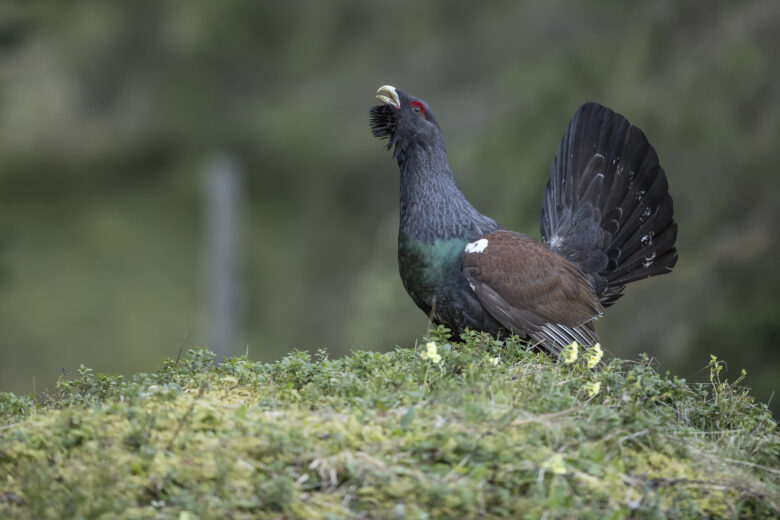
Western Capercaillie
Distribution and development

Habitat and food

Western Capercaillie habitat in the western Jura. On such mixed forest sites, regeneration consists largely of deciduous trees. This makes Western Capercaillie conservation difficult.

Prime Western Capercaillie habitat in the foothills of the Alps: spruce forest on boggy, unproductive soil. Generally, no improvement measures are necessary in these areas.

Forestry intervention to help the Western Capercaillie in a spruce forest in the northern foothills of the Alps. The aim is to enlarge the gaps visible in the background so that they extend into a dense tree population.

Western Capercaillie habitat in the western Jura. On such mixed forest sites, regeneration consists largely of deciduous trees. This makes Western Capercaillie conservation difficult.

Prime Western Capercaillie habitat in the foothills of the Alps: spruce forest on boggy, unproductive soil. Generally, no improvement measures are necessary in these areas.

Forestry intervention to help the Western Capercaillie in a spruce forest in the northern foothills of the Alps. The aim is to enlarge the gaps visible in the background so that they extend into a dense tree population.


Western Capercaillie
Birds of Switzerland

Project managers


The main limiting factors for the Western Capercaillie in Switzerland are lack of habitat (forests are too homogeneous or have too many deciduous trees) and disturbance (too many people in the mountain forests).
- Cold wet weather in June and July increases chick mortality. Disturbance by humans can amplify this effect further.
- Gaps in the forest are also important for ensuring a good food supply (insect larvae, spiders).
- In winter, the main risk for the Western Capercaillie is disturbance. If the birds are startled too often, they waste a lot of energy. This can have a negative impact on reproduction in the following spring.
- The distribution of the Western Capercaillie is monitored in all cantons where this species occurs.
- This data is essential as a basis for conservation of the species.
- Some cantons go further and have programmes for estimating the population size.
- All cantons with Western Capercaillie populations are implementing measures to improve the forest structure, mostly within special forest reserves, but in some cases also without forest reserves.
- Most cantons have set up wildlife sanctuaries for wildlife to prevent excessive disturbance in critical habitats.
- Bern University of Applied Sciences (BFH) is conducting a research project with two objectives: (a) to estimate the population size, (b) to determine what links exist between subpopulations which are sometimes located quite far apart from one another.
- A reassessment of the causes of decline in areas with decreasing trends would be useful.
- In the northern foothills of the Alps and in the Central Alps, the long-term prospects for the Western Capercaillie are good.
- In the Jura, the Western Capercaillie’s best chance of survival is at the highest sites in the western Jura (Vaud canton). The species has already disappeared from the whole of the rest of the Jura, primarily due to unfavourable changes in the forests.

The Western Capercaillie is sensitive to disturbance, particularly during the mating and breeding season (March to July). Wildlife sanctuaries are a suitable tool for protection against disturbance.
In the case of the Western Capercaillie, the goal is not really “patchy vegetation” but “patchy” forest, i.e. with an open tree layer but also stands of mature trees.

Knowledge transfer: training and further training of responsible individuals for forestry on how to establish and conserve optimal capercaillie habitat.