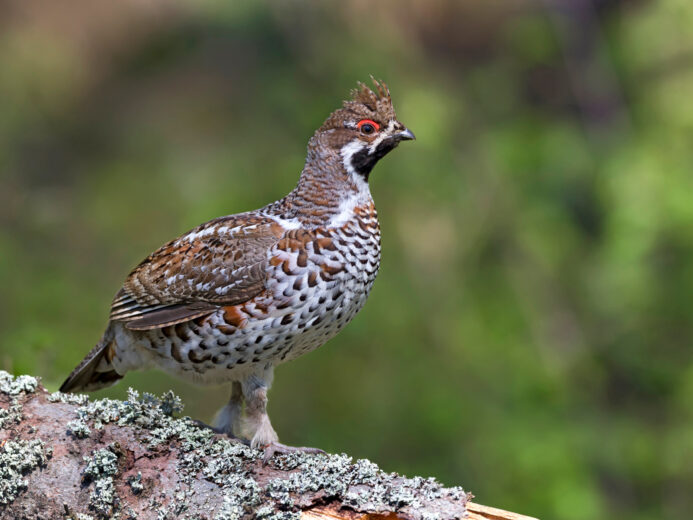
Hazel Grouse
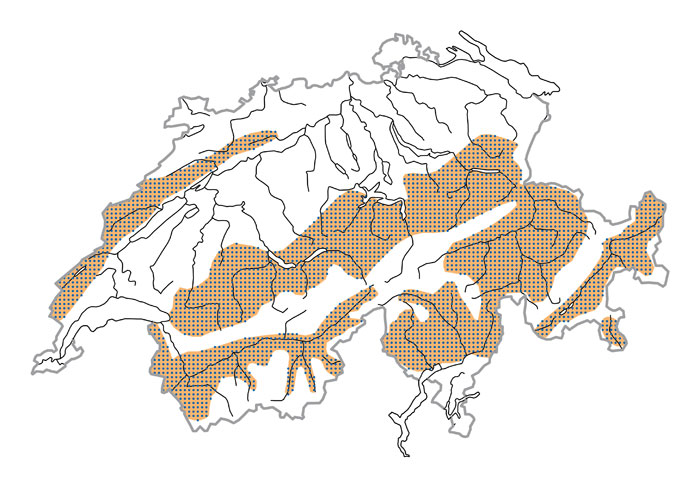
Distribution and development
Habitat and food

Rowans, bilberries and conifers in open areas provide excellent habitat for the Hazel Grouse.

Rowans and conifers in open areas, such as here in the northern foothills of the Alps, provide food and cover for the Hazel Grouse.


Hazel Grouse
Birds of Switzerland

Project managers


By far the most important limiting factor for the Hazel Grouse in Switzerland is the structure of the forests. Hazel Grouse need a minimum proportion of conifers for visual protection from predators, as well as berry- or catkin-bearing shrub species.
- The weather in the months of June and July is essential to breeding success, with wet weather increasing chick mortality.
- Good cover is important for protection against predators such as foxes, martens, eurasian goshawks and eurasian sparrowhawks.
- In winter, Hazel Grouse depend on berry- or catkin-bearing shrub species because once there is snow on the ground this is the only food they can find.
- The only monitoring of the Hazel Grouse in Switzerland is through the recording of random observations, primarily by the Swiss Ornithological Institute, and in some cases also by individual cantons.
- In the central and eastern Jura, more intensive monitoring would be key to improving conservation of the species.
- Small-scale conservation projects in individual cantons, first in Valais and Neuchâtel, now also in Uri.
- Improvements are aimed at providing sufficient space and thus, also light for its main food plants and ensuring there is sufficient cover.
- What is most needed is a project to clarify where in the Jura conservation is possible and appropriate.
- The Swiss Ornithological Institute is testing the possibility of verifying the presence of Hazel Grouse using automatic sound recording devices and analysis software.
- In the Alps (including foothills) above approx. 1100 m asl, the outlook for the Hazel Grouse is good. The conditions (coniferous forest, plenty of berry-bearing shrubs) are right.
- In the Jura, forest dynamics (retreat of coniferous species, increasing dominance of deciduous species) mean that it is likely to retreat to higher elevations, so in the long term the species will probably survive only in the western Jura.

Creating patchy forests through forest management.

Disturbance by humans, dogs or vehicles can have an adverse impact on habitats and lead to breeding losses, for example.

Conserving a minimum proportion of conifers in the tree layer provides the visual protection that the Hazel Grouse needs, especially in winter.