


The Northern Lapwing originally inhabited reedland, especially mown moor-grass meadows. When these habitats disappeared, it moved mainly to arable land, but also to grassland.
The loss of wetlands and the intensification of agricultural land use led to a sharp decline of the Northern Lapwing in the 20th century. In 2004, there were only 80 breeding pairs left in Switzerland. The population has now recovered to around 200 breeding pairs, thanks entirely to targeted protection and conservation measures.
This rare ground-nesting bird is still considered to be endangered (EN) and is reliant on targeted measures such as the establishment of suitable nesting areas left undisturbed during the breeding season (e.g. lapwing fallow plots, wet arable land) or protective fences around nesting areas to protect clutches and chicks from predators (especially foxes).

©
© Marcel Burkhardt
Conservation programme for birds in Switzerland - Priority species
Northern Lapwing
Distribution and development
Schematic distribution

Schematic distribution during the breeding season (ochre), in winter time (dotted in blue) or during migration periods (dotted in vinaceous).
Breeding bird index
The graph shows the relative evolution of the breeding population in Switzerland (100 = mean value). Example: A value of 130 means that the population in the corresponding year was 30% above the mean value of the entire period considered.
Habitat and food

©
© Lucas Lombardo
Northern Lapwings breed in wet meadows and arable fields. The Northern Lapwing can be conserved by deliberately creating this habitat.

©
© Simon Hohl
Lapwing fallow plots provide suitable breeding sites for the Northern Lapwing. The plots will not be cultivated until after the Northern Lapwing’s breeding season (image taken on 18 March 2025).

©
© Marcel Burkhardt
In wet arable fields, Northern Lapwings like to make their nests on raised ground where they are safe from flooding and ground predators.

©
© Lucas Lombardo
Northern Lapwings breed in wet meadows and arable fields. The Northern Lapwing can be conserved by deliberately creating this habitat.

©
© Simon Hohl
Lapwing fallow plots provide suitable breeding sites for the Northern Lapwing. The plots will not be cultivated until after the Northern Lapwing’s breeding season (image taken on 18 March 2025).

©
© Marcel Burkhardt
In wet arable fields, Northern Lapwings like to make their nests on raised ground where they are safe from flooding and ground predators.


Conservation programme for birds in Switzerland - Priority species
Northern Lapwing
The Northern Lapwing originally inhabited reedland, especially mown moor-grass meadows. When these habitats disappeared, it moved mainly to arable land, but also to grassland.
The loss of wetlands and the intensification of agricultural land use led to a sharp decline of the Northern Lapwing in the 20th century. In 2004, there were only 80 breeding pairs left in Switzerland. The population has now recovered to around 200 breeding pairs, thanks entirely to targeted protection and conservation measures.
This rare ground-nesting bird is still considered to be endangered (EN) and is reliant on targeted measures such as the establishment of suitable nesting areas left undisturbed during the breeding season (e.g. lapwing fallow plots, wet arable land) or protective fences around nesting areas to protect clutches and chicks from predators (especially foxes).
The loss of wetlands and the intensification of agricultural land use led to a sharp decline of the Northern Lapwing in the 20th century. In 2004, there were only 80 breeding pairs left in Switzerland. The population has now recovered to around 200 breeding pairs, thanks entirely to targeted protection and conservation measures.
This rare ground-nesting bird is still considered to be endangered (EN) and is reliant on targeted measures such as the establishment of suitable nesting areas left undisturbed during the breeding season (e.g. lapwing fallow plots, wet arable land) or protective fences around nesting areas to protect clutches and chicks from predators (especially foxes).
Birds of Switzerland

Northern Lapwing
To the species profile in the bird database
Project managers


Threats, activities and forecasts
Limiting factors and threats
Without protection and conservation measures, too few young birds survive for populations here to remain stable. What is needed are large areas of natural habitat, areas taken out of intensive agricultural use, and protection from predation.
Breeding season
- Destruction and lack of natural habitats (reed meadows, flat moorland).
- Lack of undisturbed breeding areas.
- Intensive agriculture, unintentional destruction of clutches and chicks.
- Predation (especially by foxes, also by Carrion Crows, birds of prey).
Migration/ Winter
- Hunting and poaching still occur in its wintering grounds (e.g. France).
Necessary activities
Monitoring
- Local monitoring of colonies throughout Switzerland: new breeding sites, mating activities in spring, number of breeding pairs and breeding success.
Conservation
- Protection of nests and chicks from farming operations (observing broods, advising farmers) and from predators (erecting protective fences and monitoring them).
- Creation of breeding habitats (wet meadows and arable fields, lapwing fallow plots, flood channels) and targeted maintenance (grazing, soil tillage prior to egg laying, impoundment, irrigation).
Research
- Check the validity of the threshold value of 0.8 fledglings per breeding pair needed to maintain the population.
- Determine factors influencing individual breeding success (colony size, density, weather, protective measures, breeding habitat, etc.).
- Check the effectiveness of methods offering an alternative to protective fences.
Prospects for success and prognostics
- Heavy dependence on protection and conservation measures in order to achieve the reproduction rate needed to maintain populations.
- Climatic changes (lack of precipitation) are a challenge: providing wet areas (impoundment, irrigation) is important.
- Creating more suitable habitats is of crucial importance. The Swiss population is currently heavily dependent on the fate of a small number of colonies.
Conservation measures and stakeholders
Creating wet meadows and wet arable land
The Northern Lapwing relies on the availability of wet meadows and arable land. Northern Lapwings use these areas as breeding grounds and for rearing their young, which find sufficient food in the damp topsoil.
Agriculture
Cantons
Communities
Municipalities
Nature conservation

Set up protected areas for breeding
When meadows and arable land are cultivated, clutches and chicks are unintentionally destroyed. In order to enable breeding success, clutches are located and left undisturbed. Protecting the nesting sites with electric fences deters ground predators.
Agriculture
Cantons
Nature conservation
Private individuals

Promote extensive farming
Lapwing fallow plots and extensively used meadows and pastures are suitable breeding habitats. Here, the potential risks to broods from farming operations are minimised. Chicks find sufficient food and cover in lapwing fallow plots (photo taken on 7 May 2024).
Agriculture
Cantons
Communities
Nature conservation



Publications

©
© Marcel Burkhardt
Birds of Switzerland
Northern Lapwing
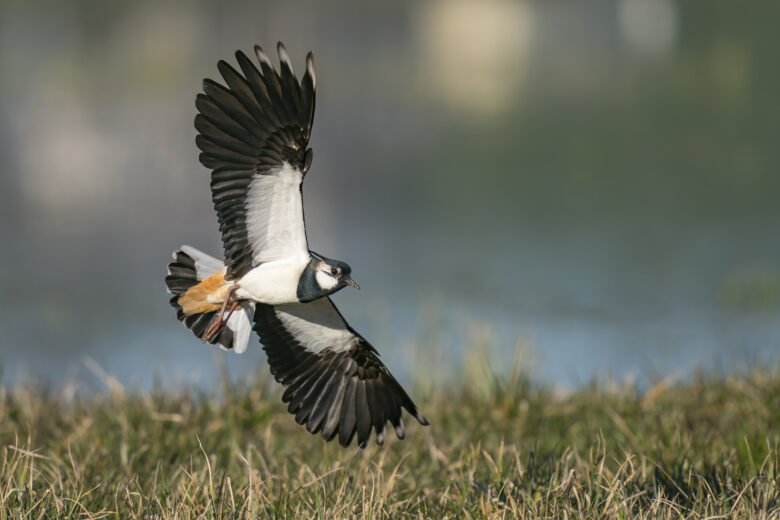
The Northern Lapwing is probably the best known wader and one of the most conspicuous inhabitants of open country. It is unmistakable due to its outline with the unique, long, wispy crest, the purple sheen of the dark plumage and its voice. It is also known as Peewit, an imitation of its mating calls. The males are especially vociferous when performing their acrobatic mating displays...
To the species profile in the bird database
