


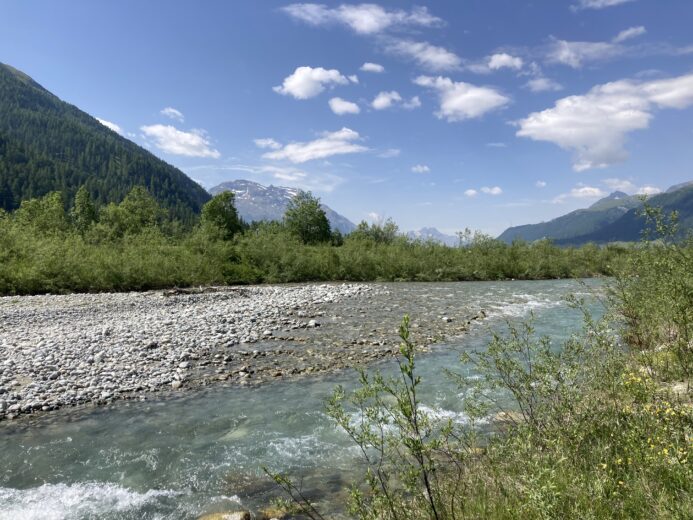
The Little Ringed Plover was originally an inhabitant of gravel banks in floodplains and estuaries. It needs vegetation-free areas of gravel and sand and regularly colonises new sites as the quality of old ones deteriorates, so it is dependent on natural river dynamics. As an adaptable pioneer species, it also successfully colonises new habitats when natural ones become scarce: these days it also nests in gravel pits, on construction sites and even on flat roofs.
In Switzerland, the Little Ringed Plover is considered to be endangered, with 90–120 breeding pairs and an uneven distribution.
The species is exposed to many threats in natural and newly colonised habitats, but can be conserved by revitalising rivers and protecting breeding sites from disturbance.

©
© Marcel Burkhardt
Conservation programme for birds in Switzerland - Priority species
Little Ringed Plover
Distribution and development
Schematic distribution

Schematic distribution during the breeding season (ochre), in winter time (dotted in blue) or during migration periods (dotted in vinaceous).
Breeding bird index
The graph shows the relative evolution of the breeding population in Switzerland (100 = mean value). Example: A value of 130 means that the population in the corresponding year was 30% above the mean value of the entire period considered.
Habitat and food


Conservation programme for birds in Switzerland - Priority species
Little Ringed Plover
The Little Ringed Plover was originally an inhabitant of gravel banks in floodplains and estuaries. It needs vegetation-free areas of gravel and sand and regularly colonises new sites as the quality of old ones deteriorates, so it is dependent on natural river dynamics. As an adaptable pioneer species, it also successfully colonises new habitats when natural ones become scarce: these days it also nests in gravel pits, on construction sites and even on flat roofs.
In Switzerland, the Little Ringed Plover is considered to be endangered, with 90–120 breeding pairs and an uneven distribution.
The species is exposed to many threats in natural and newly colonised habitats, but can be conserved by revitalising rivers and protecting breeding sites from disturbance.
In Switzerland, the Little Ringed Plover is considered to be endangered, with 90–120 breeding pairs and an uneven distribution.
The species is exposed to many threats in natural and newly colonised habitats, but can be conserved by revitalising rivers and protecting breeding sites from disturbance.
Birds of Switzerland

Little Ringed Plover
To the species profile in the bird database
Project managers


Threats, activities and forecasts
Limiting factors and threats
In Switzerland, breeding habitats suitable for the Little Ringed Plover are rare, as natural river dynamics have been lost due to watercourse straightening and the construction of hydroelectric power plants. Although the species can also use alternative habitats, these too are scarce and often suitable only on a temporary basis.
Breeding season
- Loss of natural watercourse dynamics.
- In natural habitats: disturbance caused by visitors and sudden changes in water levels (flooding) lead to breeding losses.
- In alternative habitats (e.g. gravel pits), site operations pose a risk.
Migration/ Winter
- Suitable resting or wintering areas are relatively limited, and here, too, human pressure leads to frequent disturbance.
Necessary activities
Monitoring
- Continue population monitoring, especially in areas with revitalisation projects.
- Enhanced monitoring at alternative sites: it is particularly important to identify nesting sites as early as possible, especially in gravel pits and on construction sites, so that protection measures can be taken.
Conservation
- Develop large-scale river revitalisation projects, including visitor management.
- Safeguard natural hydrological and sedimentary dynamics in rivers to create pioneer habitats.
- In alternative habitats: improve communication with stakeholders (especially gravel pit operators) so that breeding sites are protected.
Research
- Study the importance of reproductive success, survival and inward and outward migration in population trends at natural breeding sites and in alternative habitats.
- Determine the impact of disturbance and human activity on the species in the various habitats.
Prospects for success and prognostics
- Experience from several improvement projects shows that the species responds very well to the revitalisation measures taken to support it and that the number of pairs breeding in natural habitats is increasing.
- The species can survive only if sufficient habitats are available. Further efforts are therefore needed to ensure the availability of sufficient natural breeding sites, as well as alternative habitats.
Conservation measures and stakeholders

Prevent / minimize disturbances
Disturbance by humans or dogs can adversely affect habitats and lead to e.g. breeding losses. This can be prevented through information, barriers, rules or bans.
Cantons
Hunting and fishing
Municipalities
Parcs
Tourism and sport

Watercourse renaturation
Renaturalisation of watercourses, mainly by widening the riverbed, and return to natural hydrological and sedimentary dynamics.
Cantons
Communities
Municipalities



©
© Marcel Burkhardt
Birds of Switzerland
Little Ringed Plover
If pebbles suddenly appear to move on gravel or sandbanks, it may be a Little Ringed Plover. With its small fast steps it reminds one of a rolling ball, stopping suddenly then again running a small stretch. Sometimes it energetically tramples around on sand or mud to flush prey out of hiding places....
To the species profile in the bird database
