


The Common Sandpiper lives along watercourses, on gravel and sandy areas with low vegetation where it can camouflage its nest. As a result of habitat loss due to the channelling of rivers and the construction of dams, almost the entire population, numbering fewer than 100 pairs, is concentrated in the floodplains of the Alps and their foothills.
The main threats to the species in its breeding grounds are disturbance caused by recreational activities and abrupt changes in discharge volumes from hydropower plants due to hydropeaking. Multiple floodplain revitalisation projects have shown that the species responds very well to measures, provided the problem of disturbance is taken into account and visitor guidance measures are implemented.

©
© Daniele Occhiato
Conservation programme for birds in Switzerland - Priority species
Common Sandpiper
Distribution and development
Schematic distribution

Schematic distribution during the breeding season (ochre), in winter time (dotted in blue) or during migration periods (dotted in vinaceous).
Breeding bird index
The graph shows the relative evolution of the breeding population in Switzerland (100 = mean value). Example: A value of 130 means that the population in the corresponding year was 30% above the mean value of the entire period considered.
Habitat and food

©
© Verena Keller
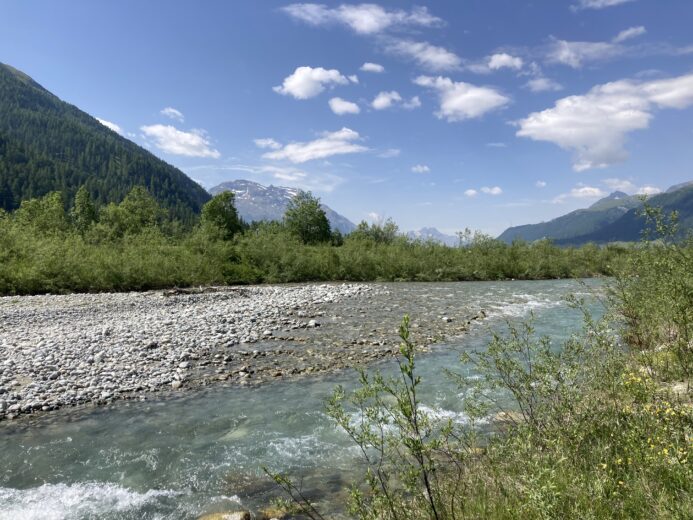
Gravel areas with pioneer vegetation near slow-flowing rivers, as shown here along the Maggia, are an ideal habitat for the Common Sandpiper.

Conservation programme for birds in Switzerland - Priority species
Common Sandpiper
The Common Sandpiper lives along watercourses, on gravel and sandy areas with low vegetation where it can camouflage its nest. As a result of habitat loss due to the channelling of rivers and the construction of dams, almost the entire population, numbering fewer than 100 pairs, is concentrated in the floodplains of the Alps and their foothills.
The main threats to the species in its breeding grounds are disturbance caused by recreational activities and abrupt changes in discharge volumes from hydropower plants due to hydropeaking. Multiple floodplain revitalisation projects have shown that the species responds very well to measures, provided the problem of disturbance is taken into account and visitor guidance measures are implemented.
The main threats to the species in its breeding grounds are disturbance caused by recreational activities and abrupt changes in discharge volumes from hydropower plants due to hydropeaking. Multiple floodplain revitalisation projects have shown that the species responds very well to measures, provided the problem of disturbance is taken into account and visitor guidance measures are implemented.
Birds of Switzerland

Common Sandpiper
To the species profile in the bird database
Project managers


Threats, activities and forecasts
Limiting factors and threats
The greatest threat is the lack of suitable habitat. The straightening and channelling of rivers has led to the disappearance of many floodplain areas. Moreover, hydropower plants have led to rivers losing their natural hydrological and sedimentary dynamics and becoming unsuitable for breeding.
Breeding season
- Human disturbance is the greatest risk during the breeding season, as floodplains are popular recreation areas. Disturbance often leads to nests being abandoned or even destroyed.
- Sudden changes in water flow are a hazard, as flooding can wash away broods.
Migration/ Winter
- Suitable resting or wintering areas are relatively limited, and here, too, human pressure leads to frequent disturbance.
Necessary activities
Monitoring
- Continue population monitoring, particularly in areas where improvement projects have been implemented or are planned.
- Targeted searches in suitable habitats to detect overlooked breeding pairs.
Conservation
- Implementation of new large-scale revitalisation projects, taking the problem of disturbance into account right from the project planning stage.
- Raising awareness and introducing visitor guidance measures in areas where this has not previously been done.
- Conservation of natural hydrological dynamics wherever possible.
Research
- Importance of breeding success, survival and inward/outward migration in population trends.
- Effect of disturbance on breeding populations.
Prospects for success and prognostics
- Experience with improvement projects shows: if the Common Sandpiper’s requirements are taken into account, its numbers can increase rapidly and significantly.
- Key aspect for the success of revitalization projects: disturbance management is taken into account right from the development phase.
- Adjustment of the legal framework will allow the implementation of ambitious river revitalisation projects to benefit the Common Sandpiper and other species.
Conservation measures and stakeholders

Prevent / minimize disturbances
Disturbance by humans or dogs can adversely affect habitats and lead e.g. to breeding losses. This can be prevented through information, barriers, rules or bans.
Cantons
Hunting and fishing
Municipalities
Nature conservation
Tourism and sport

Watercourse renaturation
Renaturation of watercourses (particularly by widening the riverbed) and restoration of habitats for species dependent on river ecosystems.
Show more
Cantons
Communities
Hunting and fishing
Municipalities


Publications

©
© Daniele Occhiato
Birds of Switzerland
Common Sandpiper
The Common Sandpiper often stops while searching for food and bobs its rear body. Its flight action is highly distinctive with bursts of fast, shallow beats interspersed by short fleeting glides, at the same time making clear, high-pitched calls. The last 100 breeding pairs in Switzerland breed in semi-natural river floodplains in the Alps....
To the species profile in the bird database
