


©
© Marcel Burkhardt
Conservation programme for birds in Switzerland - Priority species
Bearded Vulture
The Bearded Vulture is one of the most iconic birds of the Alpine mountains. It nests in the heart of winter on a cliff, in an eyrie hidden from view, on a ledge well sheltered from the elements, which it may reuse several times. It occupies vast territories rich in avalanche corridors, gliding over them in search of carcasses, on which it is the last to feed, living mainly on bones. Eradicated from the Alps at the end of the 19th century, it was successfully reintroduced there from 1986: by 2025, there were 35 breeding pairs in Switzerland, representing a third of the Alpine population. To protect it, collisions, poisoning and disturbances at nests must be prevented.
Distribution and development
Schematic distribution

Schematic distribution during the breeding season (ochre), in winter time (dotted in blue) or during migration periods (dotted in vinaceous).
Breeding bird index
The graph shows the relative evolution of the breeding population in Switzerland (100 = mean value). Example: A value of 130 means that the population in the corresponding year was 30% above the mean value of the entire period considered.
Habitat and food

©
© Julia Wildi
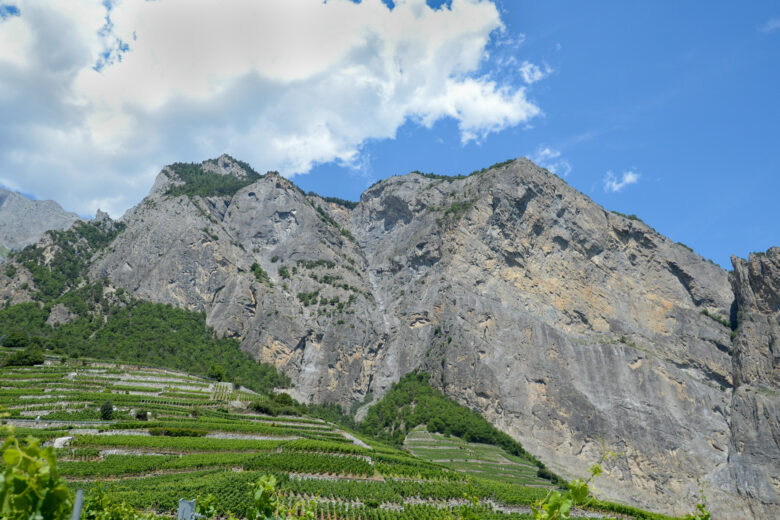
The Bearded Vulture favours rugged alpine habitats rich in cliffs.

©
© Julia Wildi
The Bearded Vulture is one of the few species of birds to nest in the middle of winter.


Conservation programme for birds in Switzerland - Priority species
Bearded Vulture
The Bearded Vulture is one of the most iconic birds of the Alpine mountains. It nests in the heart of winter on a cliff, in an eyrie hidden from view, on a ledge well sheltered from the elements, which it may reuse several times. It occupies vast territories rich in avalanche corridors, gliding over them in search of carcasses, on which it is the last to feed, living mainly on bones. Eradicated from the Alps at the end of the 19th century, it was successfully reintroduced there from 1986: by 2025, there were 35 breeding pairs in Switzerland, representing a third of the Alpine population. To protect it, collisions, poisoning and disturbances at nests must be prevented.
Birds of Switzerland

Bearded Vulture
To the species profile in the bird database
Project managers


Threats, activities and forecasts
Limiting factors and threats
Collisions with various man-made structures (e.g. power lines) and disturbances at the nest are the greatest dangers for the Bearded Vulture. It is also susceptible to poisoning (lead, poisoned bait, illegal feeding).
Breeding season
- Highly sensitive to disturbances during the nesting period.
- Helicopter flights near the nest, the presence of wildlife photographers, climbing or other outdoor sports are major sources of stress.
Migration/ Winter
- The Bearded Vulture travels long distances in search of food, but is well adapted to winters in Europe and nests in this season.
- Overhead cables, power lines, wind turbines and other man-made structures can cause fatal collisions.
Necessary activities
Monitoring
- Continue monitoring breeding pairs to track nesting success rates.
- Actively seeking new pairs to minimise the risk of disturbances.
- Collection of genetic material to monitor changes in genetic diversity within the Alpine population.
Conservation
- Contact with airlines to designate no-fly zones around nests.
- Raising awareness among outdoor sports enthusiasts and photographers to prevent disturbances at eyries.
- Marking of poorly visible overhead cables or power lines.
Research
- Monitoring the population: updating the demographic analysis to assess the success of the reintroduction programme.
- Genomic analysis of the reintroduced population.
- Research on the movements of individuals equipped with GPS trackers.
Prospects for success and prognostics
- The Alpine population is currently growing and is expected to double over the next ten years if the current trend continues.
- Adult mortality is the most limiting factor.
- Nine additional adult deaths per year would suffice to cause the population to decline, hence the importance of preventing avoidable accidents, i.e. those related to human activities.
Conservation measures and stakeholders

Remediate dangerous cables / masts
Collisions and electric shocks can be prevented through appropriate marking of cables.
Cantons
Industry and commerce
Municipalities

Prevent / minimize disturbances
Disturbances caused by humans or aircraft near the nests can lead to breeding failures.
Cantons
Hunting and fishing
Tourism and sport


Publications

©
© Marcel Burkhardt
Birds of Switzerland
Bearded Vulture
The Bearded Vulture is the largest bird in the Alps with a wing span of over 2.6 metres. In the past, many myths prevailed about this vulture, which is still evident in the non-scientific names such as “Rossgyr” (horse vulture), “Gemsengeier” (chamois vulture) or “Lämmergeier” (lambs vulture). By the end of the 19th century it was deliberately decimated and finally exterminated in Sw...
To the species profile in the bird database
